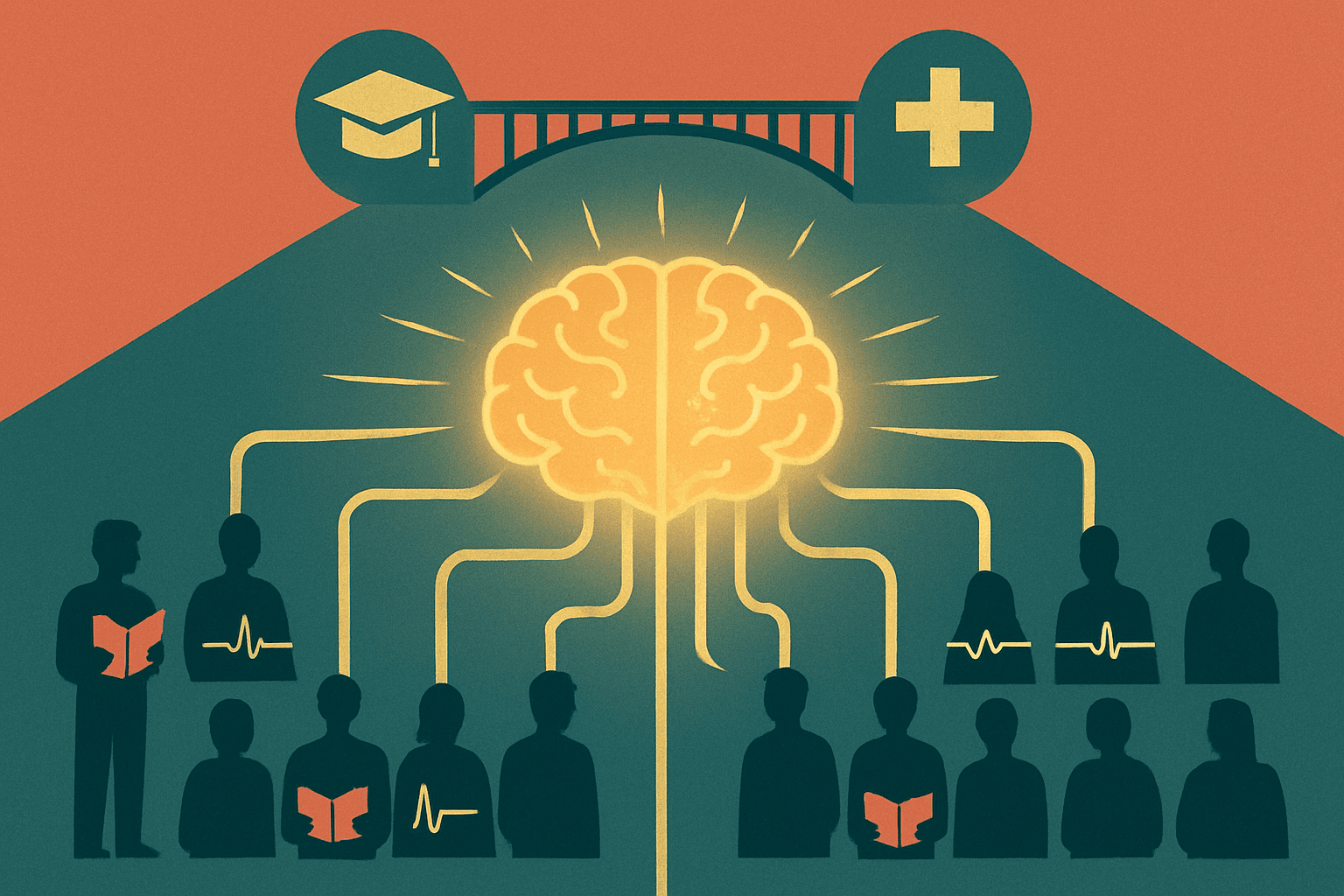
Someone asked me recently: "You're a software education guy. Why are you working with physicians and public health scholars?"
Simple answer: the pain point is identical.
In education: expert knowledge is trapped inside teachers' heads and doesn't scale. In health promotion: expert knowledge is trapped inside clinicians' heads and doesn't scale.
AI solves the same problem in both: how do you safely replicate one person's judgment for ten thousand people?
Where's the AI Opportunity in Health?
To be clear: I'm not talking about medical AI (that requires FDA/TFDA certification — way too high a barrier for my approach).
I'm talking about health promotion — helping people not get sick before they get sick.
Characteristics of this field:
- No medical-grade certification required (not diagnosis, not treatment, not prescribing)
- Massive scaling demand (23 million Taiwanese need health management, but there aren't enough dietitians and health coaches)
- Knowledge is deterministic (dietary guidelines, exercise prescriptions, chronic disease prevention — not the gray areas of clinical medicine)
- Current delivery is extremely inefficient (one health educator can only face-to-face counsel 20 people per day)
Eric Topol made a point in Deep Medicine that resonates:
AI's greatest contribution to healthcare isn't more accurate diagnosis — it's giving physicians' time back to patients. One step further — it's preventing people from becoming patients at all.
Health promotion is that "preventing people from becoming patients" step.
What I'm Actually Doing
Scenario 1: Health Promotion Workshop for Practitioners
Collaborating with the Taiwan Health Promotion and Education Association (THPEA) to teach health promotion practitioners (health educators, nurses, public health workers) how to use AI from scratch.
These people:
- Have extremely strong domain knowledge (nutrition science, exercise physiology, behavior change theory)
- Can't write code at all
- Spend huge amounts of time on "translating knowledge into patient education handouts" — manual labor
I don't teach them to code. I teach them to structure their expertise so AI can do the translation for them.
A dietitian's education knowledge → structured into prompt templates → AI auto-generates personalized dietary recommendations. A physical therapist's exercise prescriptions → structured into decision trees → AI matches questionnaire responses automatically.
Result: one dietitian's output goes from "20 handwritten education sheets per day" to "200 personalized recommendations per day."
Scenario 2: Case Management Digitization at a Medical Center
A pharmacist team at a major medical center tracking hundreds of medication cases daily — all on paper + Excel.
The pain point isn't "AI judging drug interactions" (that needs certification). It's:
- Cross-department consultation info is fragmented (cardiology and nephrology prescribe conflicting drugs, but neither sees the other's records)
- Case tracking is fully manual (which patient needs follow-up? whose lab values are abnormal?)
- Security requirements are extreme (hospital-grade RBAC + penetration testing)
I built systems engineering: integrating fragmented information flows into one system so pharmacists can see the full picture at a glance instead of flipping through ten paper folders daily.
AI's role here isn't "replacing pharmacist judgment" — it's "helping pharmacists see what they need to see, faster."
Why Software Education × Health Promotion Works
What I spent 18 years doing: helping teachers use technology for education. What I'm doing now: helping health experts use technology for health education.
The underlying pattern is identical:
| Education | Health Promotion |
|---|---|
| Teacher's pedagogical knowledge | Health educator's promotion knowledge |
| Student learning journey | Citizen health journey |
| Personalized learning paths | Personalized health plans |
| Learning outcome assessment | Health behavior change assessment |
| AI Tutor | AI Health Coach |
The only difference is domain knowledge. System architecture and AI application patterns map nearly 1:1.
This is why I can enter this space — not because I understand medicine (I don't), but because I understand "how to systematize expert knowledge + use AI to scale it."
Three Pits in This Field
Pit 1: Treating "health advice" as "medical advice"
Health promotion can say: "Walking 30 minutes daily benefits cardiovascular health." It cannot say: "Your blood pressure is high, I recommend drug XXX."
The former is public health education. The latter is a medical act. AI system outputs must have clear red lines — my systems hard-code "no diagnosis, treatment, or medication recommendations" as constraints in prompts.
Pit 2: Thinking "with AI we don't need experts anymore"
AI can't replace a dietitian's judgment. It can only scale judgments the dietitian has already made.
My approach: experts first build a golden set using real cases (gold-standard answers). AI output must align with the golden set. Deviate too far → fallback to human review.
Identical to what I do in education — AI Tutors can't replace teachers, only scale the teaching flow teachers have already designed.
Pit 3: Treating "AI adoption" as a one-time project
Health promotion is long-term behavior change, not "install an app and done." AI systems need:
- Continuous knowledge base updates (new dietary guidelines, new exercise research)
- Continuous outcome tracking (did this recommendation actually change behavior?)
- Continuous prompt iteration (last month's prompt may not fit this month's user cohort)
This is why my service model is "long-term advisory" not "build and walk away" — this domain never has a "done" state.
Advice for People Doing AI × Health
If you're from tech:
- No medical degree needed, but find a domain expert partner (dietitian, physical therapist, public health scholar)
- Understand the "health promotion vs. medical practice" red line first
- Start with "scaling existing expert knowledge," not "AI autonomous judgment"
If you're from health promotion:
- Your domain knowledge is the biggest asset — AI lacks not algorithms, but the knowledge in your head
- Learn to "structure knowledge" (decision trees / checklists / templates) before learning to code
- Find a technical partner: you bring knowledge, they bring architecture
If you're from the healthcare system:
- Start with "information integration" (connect fragmented paper/Excel/systems), not "AI diagnosis"
- Security is always priority #1 (hospital IT departments are strict — that's a good thing)
- Highest-ROI entry point: "reduce manual transcription time," not "replace physician judgment"
Closing
AI × health isn't a new buzzword. It's a very specific question:
How do you make one dietitian's knowledge serve ten thousand people without sacrificing quality?
This is the same question as "how do you make one great teacher's pedagogy teach ten thousand students without sacrificing quality?"
I spent 18 years answering the education version. Now I'm starting on the health version.
The answer to both: Don't replace experts. Systematize their judgment, then scale with AI.
If you're working on something similar, let's talk.